

If you’ve been working with Java for a while, you know how painful boilerplate code can get. That’s exactly why Java Record is one of the most exciting additions to the language. It’s lightweight, clean, and solves real-world problems that developers face daily. In this guide, we’ll break down the Record Features and Benefits that make it worth your attention. You’ll see why records can simplify your code, boost performance, and improve readability—all with minimal effort. Stick around, because by the end, you’ll not only understand what Java Record is but also know exactly when and how to use it effectively.
Table of Contents
1. What is a Java Record?
A Java Record is a special kind of class introduced in Java 14 (as a preview) and made stable in Java 16. Records are designed to hold immutable data with less boilerplate code compared to traditional classes. In simple terms, records act as data carriers. Moreover, they remove the need to write repetitive methods like getters, equals(), or toString().
Java Record is one of the standout features of Java 16, offering developers a concise and effective way to define and create immutable data containers. Gone are the days of writing boilerplate code to create classes with parameterized Constructor, getters, toString(), equals, and hashcode methods – with Java Record, all of that is handled for you with just a single line of code. This not only streamlines your development process but also makes your code cleaner and more maintainable.
One of the key benefits of Java Record is its immutability, meaning that once a record is created, its state cannot be changed.
➡️ External Reference: Java Records (Oracle Docs)
2. Why Java Introduced Records
Java has always been verbose when it comes to data classes. Defining a simple Person class required writing multiple methods, which increased code length and reduced readability. Consequently, developers were spending more time maintaining repetitive code. Records were introduced to address this challenge by reducing overhead and promoting simplicity.
3. Record Features and Benefits
3.1. Reduced Boilerplate Code
Traditionally, a class with just two fields requires constructors, accessors, and overridden methods. With Java Record, you achieve the same functionality in one line. Therefore, your codebase remains clean and concise.
3.2. Built-in Immutability
Fields in a record are final by default. This ensures data integrity and prevents accidental modifications. As a result, records are especially helpful in multithreaded environments.
3.3. Easy-to-Read Data Structures
Records are concise and self-documenting. Instead of scanning through multiple lines, you can understand the data model at a glance.
3.4. Pattern Matching Compatibility
Records integrate seamlessly with pattern matching for switch and instanceof. Consequently, they improve functional programming capabilities in Java.
3.5. Better Performance with Simplicity
Because records avoid mutable state and cut down boilerplate, they lead to fewer bugs and better runtime performance. In addition, debugging becomes much simpler.
4. Code Examples with Java Record
Traditional Class Example :
					public class Person {
    private final String name;
	private final int age;

	public Person(String name, int age) {
		this.name = name;
		this.age = age;
	}

	@Override
	public int hashCode() {
		return Objects.hash(age, name);
	}
	@Override
	public boolean equals(Object obj) {
		if (this == obj)
			return true;
		if (obj == null)
			return false;
		if (getClass() != obj.getClass())
			return false;
		Person other = (Person) obj;
		return age == other.age && Objects.equals(name, other.name);
	}

	public String getName() {
		return name;
	}
	public int getAge() {
		return age;
	}

	@Override
	public String toString() {
		return "Person [name=" + name + ", age=" + age + "]";
	}

}
Same Example with Java Record :
public record Person(String name, int age) {}
That’s it! No need to write constructors, hashcode(),equals(),getters, or toString(). The compiler generates them automatically.
Pattern Matching Example :
					// Define a sealed interface Shape (requires Java 17+)
sealed interface Shape permits Circle, Rectangle, Triangle {}

// Define Records
record Circle(double radius) implements Shape {}
record Rectangle(double width, double height) implements Shape {}
record Triangle(double base, double height) implements Shape {}

public class Main {

	// Method using pattern matching in switch expression
	public static String describeShape(Shape shape) {
		return switch (shape) {
		case Circle c -> "Circle with radius: " + c.radius();
		case Rectangle r -> "Rectangle with width: " + r.width() + " and height: " + r.height();
		case Triangle t -> "Triangle with base: " + t.base() + " and height: " + t.height();
		};
	}

	public static void main(String[] args) {
		Shape s1 = new Circle(5.0);
		Shape s2 = new Rectangle(4.0, 6.0);
		Shape s3 = new Triangle(3.0, 4.0);

		System.out.println(describeShape(s1)); // Circle with radius: 5.0
		System.out.println(describeShape(s2)); // Rectangle with width: 4.0 and height: 6.0
		System.out.println(describeShape(s3)); // Triangle with base: 3.0 and height: 4.0
	}
}
5. When to Use Java Record
You should use a Java Record when:
You need immutable data classes.
You want to represent DTOs (Data Transfer Objects).
Cleaner and less verbose code is required.
You are working with pattern matching or functional programming features.
For example, API responses, database results, or simple domain models are perfect candidates.
6. Limitations of Java Record
Despite their strengths, records are not suitable for all cases:
You cannot extend another class (records are
final).Fields are immutable, so no setters are allowed.
They are primarily for data-holding purposes, not complex logic.
7. Conclusion
The Java Record feature simplifies code, improves readability, and ensures immutability. By understanding the Record Features and Benefits, developers can create cleaner, safer, and more efficient applications. If you are using Java 16 or later, records are worth adding to your toolbox.
In conclusion, Java Record is a game-changer for Java developers, offering a simple and efficient way to define immutable data containers with all the necessary methods included. With its powerful features and benefits, Java Record is a must-have for any Java developer looking to streamline their code and improve the quality of their applications. So, if you haven’t already explored the world of Java Record, now is the time to dive in and discover the many ways it can enhance your development process. Happy coding!
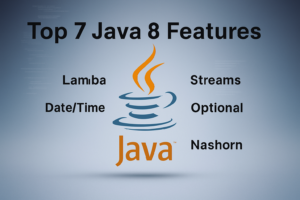

Java 8: 7 Powerful Features That Changed the Game
Java 8 brought a revolutionary shift to the Java programming language, empowering developers with modern programming capabilities like functional programming, cleaner APIs, and better concurrency
🚀 Evolution of Java: From Java 8 to Java 24 – Key Features You Should Know
Introduction: Have you ever wondered how Java has evolved over the last decade—and what makes each version worth upgrading to? From the game-changing introduction of